This is not my recipe.
This is Uncle Richard’s recipe, and it came to me like a food writer’s dream.
A soap box I am forever willing to scream loudly from is that recipes are allowed to come with stories. Not only are they allowed to, but they benefit from, being tethered to something deeper.
I feel it makes the eating experience so much more meaningful.
That can be as deep as an old familial recipe passed down through generations, or it can be one, singular prawn in garlic you ate on a holiday that takes you back to the fleeting romance of a warm sunset.
It can be bother as deep as an ocean or as shallow as a bird bath, and both, in my opinion, hold the power of effective storytelling.
That’s why I can never divorce a recipe from its origin story.
I wrote about this feeling at length in this blog post, and if you are someone who likes to look at how ordinary joys can speak to some of the enormous truths of how we live, then it could be a read for you.
And then come back here and make this, because I believe this recipe has a particular sentiment in our home, and I’m so delighted to share it here.
Uncle Rich was my partner’s uncle, and though he is no longer with us, his enormous presence is with us every day, not only in how we talk about him, but in how we eat and cooking. He’s in our dining table (which he made for us) and our chopping boards and our shelving (can you tell he was a genius with woodwork?) and, as he was an enormous food lover, in our reading material!
We have the privilege of owning some of his most-loved and cherished cookbooks, which are beautifully crumbling to pieces, dog-eared in corners, and bound by masking tape. That’s if we’re lucky, because this particular recipe, came to me outside of it’s original two covers.
It came to me scribbled across the back of a ripped and open envelope, chaotic in instruction and sparse in detail, instinctively scrawled and pulled from muscle memory; a reminder more than a recipe, and I cherish that envelope with my life.
Of course, as a recipe writer, it’s a challenging feat to force structure into something that exists in spite of it, but alas, I had to shape it into something that could be useable if I wanted to share this delight with my readers.
However, having said that, I have changed very little. Purposefully, so.
The ingredients and flavour profile, which is, ultimately, what I want every time I eat it, have remained the same as the envelope, but my contribuition has been to formalise quantities, timings and method, because on the envelope, under a list of ingredients, it just reads ‘3 HOURS’.
Fab though that is and speaks to so much of the trust and instinct that a home cook can develop over time, unfortunately, you will need more information if you want to get as close as possible to this beautiful stew.
And beautiful it is.
It’s a proper hearty stew. The term ‘man’s man’ is garbage and has absolutely no standing in today’s society, buuut, if we took the ethos of what that statement is supposed to mean and apply it to this, then this is a stew’s stew.
The hob does most of the work, blipping away with the odd stir until the meat is tender, the gravy is rich and the pot is dark, deep, and savoury with little pockets of sweetness coming from the vegetables and bacon bits.
Like I said, I changed nothing, but that’s not to say you couldn’t?
Let’s talk.
Booze – I use Newcastle Brown Ale because that’s what the envelope told me to use, but I think any malty brown ale would work great. Nothing too light and hoppy here though, the beauty is in it’s dark viscocity. For that reason, I can’t recommend a white wine either. You want a dry, full-bodied red (love that term) which is slightly sweet in contrast to the malty brown ale.
Vegetables – would a parsnip work well in place of swede or carrot? Yes, it would. A mushroom would be welcomed too. Turnip? Sure. Maybe even those tiny little pickling onions, although they remain a b*st*rd to peel.
Meat – nothing other than beef will do here, I’m afraid. And while I’ve used stewing steak, for ease because that’s what’s always in my supermarket, a beef shin or chuck would be a great alternative if needed.
Spices – you’ll notice an absence of seasoning here (other than salt and pepper) but that’s because the booze pairing does a lot of the heavy lifting, but that’s not to say you couldn’t add a little smoked paprika or cumin even a tiny dusting of nutmeg to the vegetables while frying. You may love their addition, but you won’t miss their absence either.
Herbs – throw a sprig of thyme in, if you’re feeling the vibe. No rosemary. I still need to write a post coming out of the closet for how much I dislike rosemary these days.
Serving suggestions – potatoes and a green vegetable like green beans or broccoli is our go-to, but a lovely tangle of cabbage or kale would also be fab. My partner insists, with little resistance from me, on throwing a Yorkshire pudding on the side of this stew too. Not adverse to it, I won’t lie, but, I must ask, is this an English thing?
I hope you enjoy this recipe as much as we do.
It’s as gentle to make as it is comforting to eat, and is so generous in it’s abundance, which is also such a lovely feeling knowing that it was born from a man who had such generosity in his soul.
And that, if I’m honest, is why I can never separate recipes and their origin source.
Recipes like this allow us to remain reminded of people who came before us, who helped us and loved us and shaped us, so that we can continue to share meals with them forever.
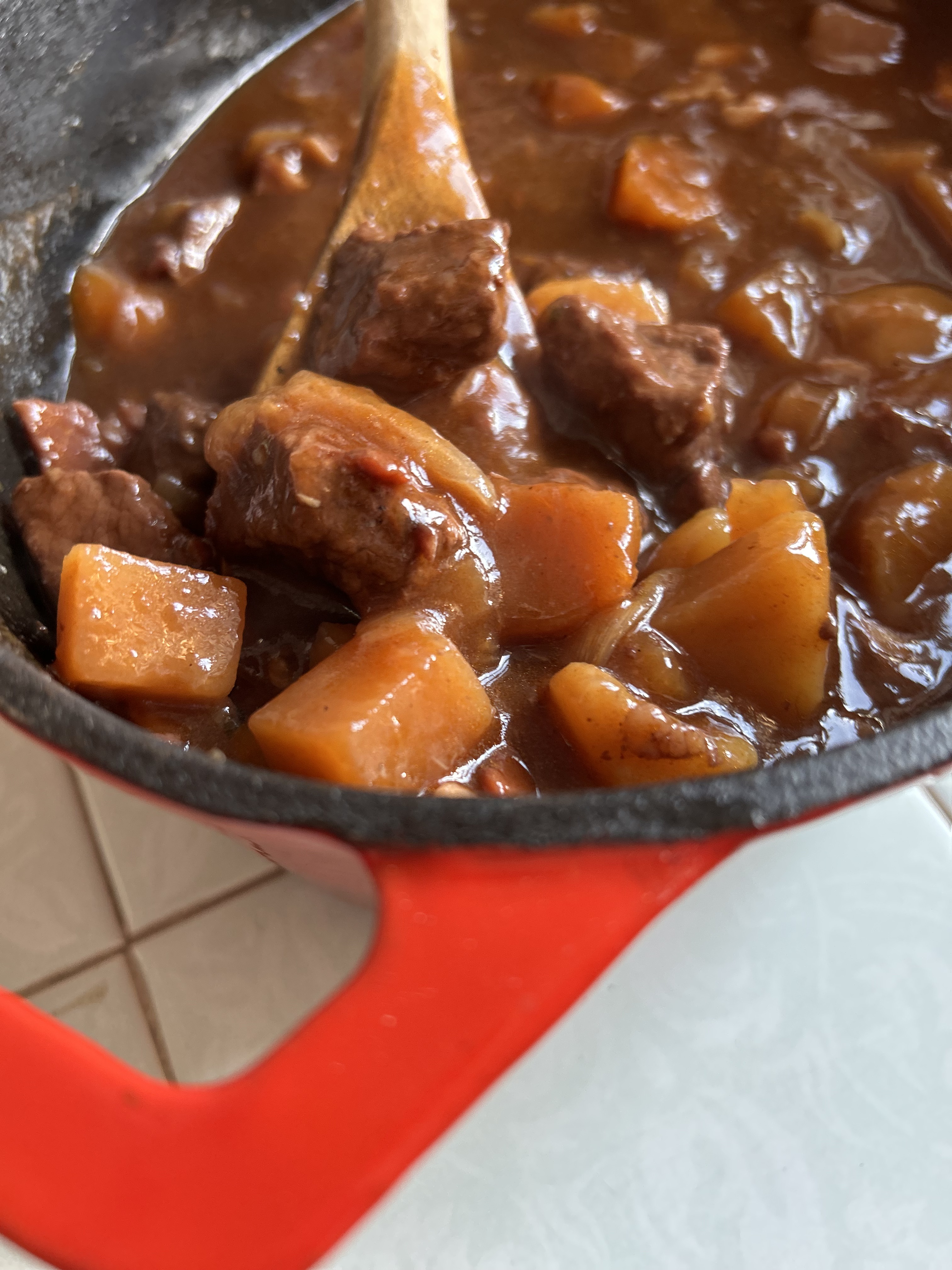
Serves 6 – 8
1 tbs vegetable oil
Approx 1.5kg stewing steak – room temperature and cut into chunks
4 strips smoked, streaky bacon – roughly chopped
2 onions – peeled and chopped
3 carrots – peeled and cut into chunks
1 small swede – peeled and diced
3 cloves garlic – finely chopped
Approx 100g tomato paste
500ml Newcastle Brown Ale (or other brown ale)
380ml red wine
4 medium potatoes – peeled and cut into chunks
BEFORE WE BEGIN – The most aggravating task for any stew is the peeling and chopping of vegetables and meat. Absolutely nothing worse than getting halfway through a recipe and seeing you need to peel and chop a swede. I’d rather collapse. So, I suggest getting everything peeled and chopped and prepped as instructed in the ingredients list first, before continuing. Potatoes included. Just peel and cut them, pop them in a large jug or bowl and cover them in water to keep them from going weird until you need them. I’ll assume your ingredients are prepped as advised in the ingredients list before continuing with the below!
- Heat the oil over a medium-high heat in a large casserole or heavy pot (say cast iron) that comes with a lid, and then brown the beef with a little salt and pepper until coloured but not necessarily cooked through. You may need to do this in batches depending on the surface area of your pot. Remove from the pot, add to a small bowl and set aside just for now.
- Add the bacon and fry until it has rendered a lot of its fat and starting to brown. Crisp it if you can be bothered to wait. Remove and add to the little bowl of beef, leaving just a little gleaming puddle of fat in the pot.
- Fry the onions, carrots and swede with a little more salt and pepper for about 10 minutes, stirring now and then, just so they start to soften.
- Add the garlic and cook again for a few minutes.
- Add the tomato paste and stir, cooking for a further 5 minutes to cook the tomato paste, stirring as you go, and it’s fine if anything catches to the bottom of the pot.
- Pour in the brown ale and red wine, stir well and scrape the pan to release any vegetables that may have caught the bottom from the previous step. This is extra flavour. Lucky you.
- Add the little bowl of beef and bacon to the pot, including all the liquid that may remain in the bowl, and stir into the ale and wine. Raise the heat and bring the pot to a bubble, and then drop the heat to a simmer.
- Cover with a lid and keep on the hob for 2 hours, just casually stirring from time to time.
- After this time, add the potatoes and stir. Pop the lid back on the pot and cook for a further 30 minutes.
- After this time, remove the lid, stir, and cook for a further 30 minutes, allowing the stew to reduce a little. At this point the beef should be melting and tender, and a potato and carrot could crush gently with a little pressure from a spoon pressing it against the wall of the pot.
- Taste for seasoning, you may want to add a little salt and pepper, and then remove from the heat.
- Serve hot with crusty bread and see intro for serving suggestions.


Leave a Reply