You know how people start losing their minds when they see the Coca Cola Truck?
Like it’s permission, or something, to roll your sleeves right down to your knuckles, drink warm, spicy drinks with both hands, and start making lumpy soups?
Well, you know what my version of that red truck is?
The red treacle tin.
There’s something about that tin.
Its whimsy is one thing, that lion gets me every time, but it’s that bright, cardinal red backdrop against that royal gold arch, I think, that really tugs at the strings of my heart. It just makes me feel so ready for the season.
I don’t, really, tend to cook with treacle before October, so the minute the month hits, I suddenly am reminded of what’s possible, and more excitingly, what’s to come from that moment on.
Another thing it tends to remind me of, SIDE STORY – I’m sorry – is that I once lived in a block of flats and threw a tin of treacle in the bin. In said bin, it must have got mixed up with some other liquid to make it runny, and, unbeknownst to me, there was a hole in the bin bag. So when I carried the bag down to the communal bin area (down two flights of stairs, across a large landing, into the lift, down seven floors, through the foyer, through two corridors) I actually left a very, very long, thick inky black trail of treacle behind me, from my kitchen corner right down to the big skip.
This is why I could never commit m*rder. I’d tell on myself instantly.
BUT ANYWAY.
This bake.
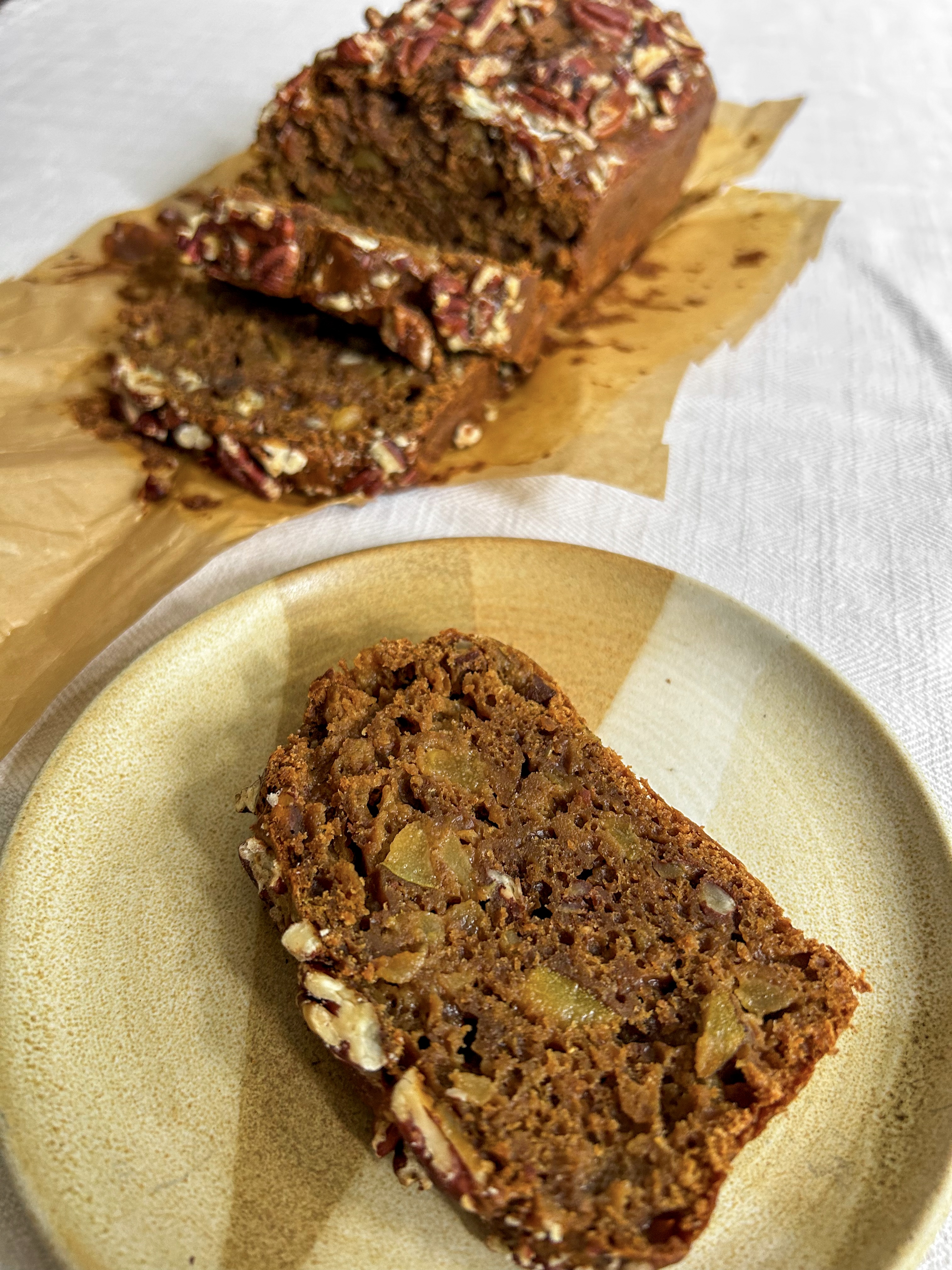
It’s exactly what I want in a bake this time of year. Dark, heavily spiced, just a slight suggestion of sweetness, and silky, chubby morsels of pear keeping the crumb moisty while pairing with the robust crunch of pecans. I love fruit cake so much, but only, really, when it can retain moisture, which I feel some fruit cakes don’t really have.
Is that a lie they’re telling us?
You know when people say ‘oh, fruit cakes last forever because there’s so much moisture’ – moisture, WHERE? Because I slice into some fruit cakes and it falls into a chunky, dry landslide of asphalt? Where is the moisture?
So when I make a fruit cake, I want it to have a real, dense, moist crumb that’s not cloying or claggy. And admittedly, that is hard to nail.
A loaf cake can be perplexing. If the batter is quite liquid, it will take forever to bake, if the batter is too thick, the loaf could be too dense and so on – so trying to get it right is a challenge in itself. That’s why I played around with a few different approaches to this recipe before I settled on the one I was happy with.
See below for the scrawling ramblings of a mad man (see also: my process)

But anyway, the reason why I liked the version below is because I know not everybody’s oven runs to the same temperatures so what could take 40 minutes for me could be 50 for another, and so on. That’s why I believe the below recipe is the perfect balance of moisture AND thick batter, which means you can cook it for as long you need to for it be cooked through without drying it out.
See below.
Moist crumb, as promised.
Some thoughts:
Yogurt – that moisture content was important for me to get right, so you’ll see I do use some Greek yogurt in the recipe in place of butter or oil. You’ll also see from the above notes that I actually wanted to use butter, but didn’t have any in. We adapt in challenging situations, because why? I’m too lazy to walk to the shop. But I had yogurt, and improvised. I enjoyed the moisture so much that I didn’t bother testing with butter, I’m afraid. But natural yogurt in place of Greek would be fine, tbh.
Fruit – ripe but firm pears are better for this. A soggy, sagging, soft pear might release too much moisture. You want bold chunks. If you can easily puree the pear chunk with the back of a spoon, it’s too saft.
Fruit II – apple would also work.
Fruit III – would dry fruit work? Don’t know. Try it and let me know.
Chocolate – not for me in this, although cocoa powder did cross my mind at some point during development, but that would’ve taken it in a whole new direction that I didn’t have the mental brain space for. But 50g dark chocolate chunks would be a nice addition.
Spices – you see ground coriander there, but you’ll also see on the side of my notes I played around with a few different spice blend variations. All are good. Go with your favourites. Be bold with them though. Have strength in your convictions. When it comes to dry spices, anything less than a teaspoon won’t be noticed, in my opinion.
Nuts – I love pecans with their mapley bitter sweetness. But walnuts would be fine. Cut them by hand. And toast them. Some of you are not toasting your nuts before using them, and it shows.
Mixing – this is fine with a bowl and spoon. I made it with a bowl and spoon. I also made one in an electric mixer. Both turned out the same.
Tins – like I said, the baking time mentioned below is a guide. Stoneware, like Le Creuset, which is what I used, may take much longer than something thin and metal. So I plan for anything from 70 – 90 minutes, skewer testing in intervals of 10 minutes after the 70 minute mark, until it’s baked through. Don’t trust the clock for all of it.
Storing – Once it’s cool, it will keep in an airtight container for like… 4 or 5 days.
Okay great.
Are we reay?
Get the tin out lads.
It’s time.
Cuts 8-10 slices
2 medium but ripe, firm pears
90g pecans
200g plain flour
1 tsp baking powder
½ tsp bicarbonate of soda
1 tsp ground cinnamon
1 tsp ground coriander
A grating fresh nutmeg
100g dark treacle
100g soft brown sugar
2 medium eggs
150g Greek or natural yogurt
1 tsp vanilla extract
- Preheat the oven to 150°C (170°C non-fan) and line a loaf tin with baking parchment. I cannot stress to you enough how lazily I do this. Literally just stuff it in. You can’t make me cut baking parchment with a scissors. I shan’t. My least favourite kitchen task.
- Anyway, I always start by peeling, coring, and chopping the pears. Only because, I can’t bare it in recipes when you’re halfway through and the writer reminds you that have to do that to fruit. Cannot bear it. As if you haven’t got enough on, already. So yes. Peel, core, and chop the pears into small pieces.
- Similarly, toast the pecans. Nothing worse than realising this halfway through. I like to get the pears and pecans done and out of the way so then it’s nothing but pouring and mixing. So toast the pecans until they are slightly coloured and smelling of sweet, rich maple. Take them off the heat and, with a knife, cut them into a mix of nutty rubble, but keep a small handful to one side and cut into bigger chunks, so you have two piles.
- In a large bowl, mix together the finer, dusty, rubbly pecans, flour, baking powder, bicarb, cinnamon, coriander, and nutmeg, with a little salt until everything is combined. I do this with a fork.
- In another bowl, whisk together the treacle, sugar, eggs, yogurt and vanilla until evenly combined and the yogurt is fully immersed in the darkness of the treacle and sugar.
- Tip the wet ingredients into the dry, folding gently. You don’t want to overmix, but you want to make sure there are no little dry pockets of flour still hanging about in the mix.
- Now add the pears, and fold gently once or twice so that the pear pieces are as evenly dispersed as possible.
- Pour the mixture into the prepared tin, using a rubber spoon or spatula, if poss, just to get every last scrap out. Level the surface as best as you can – but also, it’s a lumpy batter, so don’t lose your mind over this bit, and finally scatter over the remaining chunkier pieces of pecan.
- Put it in the oven and bake for anything between 70-90 minutes. At the 70 mark, take it from the oven and do a skewer test. It should come out without any wet batter at all, just a few little moist crumbs if anything. If it’s still wet, return the loaf to the oven for another 10 mins before checking again, continuing like this until you’re confident the skewer doesn’t have any wet batter on it. Like I said, do note that a stoneware tin will take longer than a metal tin. If you think the nuts are browning quicker than the batter is baking, you can cover the top loosely with some foil.
- Once cooked through, leave the loaf in its tin for like 20 minutes to cool before removing from the tin to cool further on a wire rack. Let it cool completely before slicing. It’ll be hard because it’ll look beautiful but trust, any loaf will be so much easier to slice if you’ve given it some time to rest and settle. And, don’t we all?
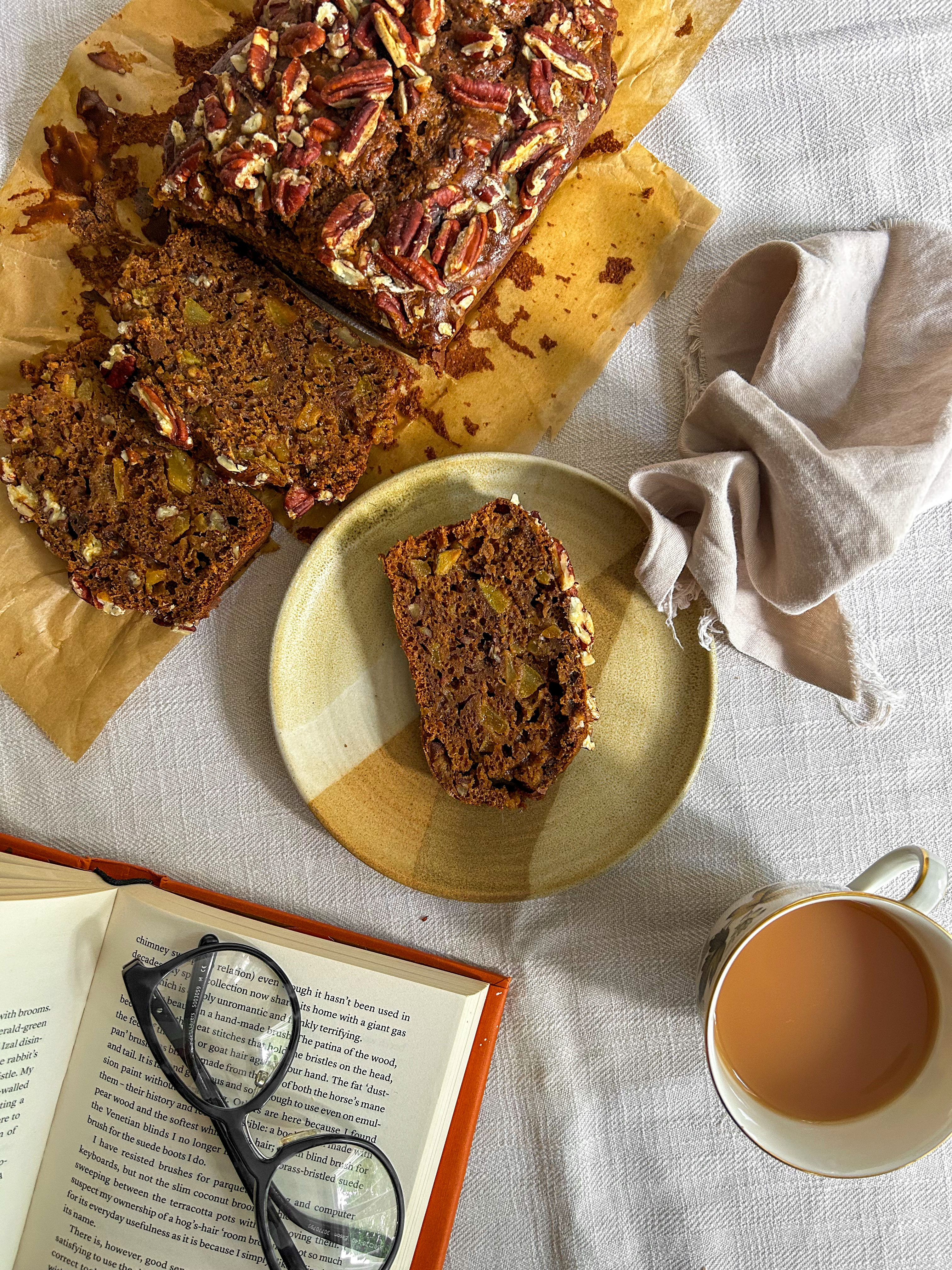
- Enjoy with a brew and, while I like it completely unadorned, it is nice with a little crème fraîche, I won’t lie to you.


Leave a Reply