Coleslaw is in an identity crisis. Always has been.
When I think of coleslaw I think of plastic Tupperware. I think of wooden benches and warm air and cold, green grass under my legs and tan lines on upper arms, pink kneecaps and burning, bald foreheads. I think of barbecue smoke, a setting sun, and debating opening one last beer, which of course, I do.
It’s picnic food, and it’s wheeled out alongside the burger, hot off the coals, and the bap, fresh out the pack, and then the slaw is forgotten about until the next time we have a heatwave, and because that is usually never, I think coleslaw needs a rebrand.
A good coleslaw is many things, but for me, it is one of the most useful side dishes, and even then, a side dish feels like such a disrespectful undersell.
Think about it. When you don’t really have much energy to think of a full meal, a coleslaw in the fridge is a third of the problem solved. With slaw in your fridge, all you need to do is roast some chicken or fry up some sausages or roast a fillet of fish or bake a potato or make a sandwich or fry an egg… you can put it on the side of anything and it will absolutely complete the meal.
It’s also just good practice in sustainable cooking.
Go with me here.
Coleslaw is a very good way to use up any bits and bobs you have hanging about that could be on borrowed time. For safety reasons it’s probably best practice for me to say to watch your use-by dates and be mindful of eating things past its prime etc, but I’ve honestly flung so many things into a coleslaw when I knew time was almost up. Of course, giving it a purpose doesn’t always give it an extended date of perishing, I know this, but I can only tell you what I do.
My recipe below, admittedly, is not a practice of using up ingredients because I make coleslaw with purpose, damn it, meaning this is how I would make my coleslaw even if my ingredients were at their freshest, because this is my perfect version of coleslaw, and I aim to have coleslaw in the fridge as often as I can.
At the time of writing, I am actually having coleslaw tonight on the side of some fried sausages and cubed potatoes and some boiled frozen peas because I haven’t done a proper food shop and that’s pretty much all I have. But I made the coleslaw last week (Thursday) to go with some homemade burgers (Friday) and now eating it again tonight (Tuesday). Honestly, the coleslaw is a saviour, I swear.
As time goes on and as my fridge is in use, it may be that I have to improvise on my perfect ideal, so of course, as always, I have some thoughts.
Cabbage – I always want white cabbage as a baseline. I don’t like straying too far away from this as a rule, but when times haven’t allowed, I have made alterations. I have made this with red cabbage and it was fine (a little more bitter, crunchier, and prepare yourself for pink cream puddles in the bowl). I have endeavoured with savoy (softer, sweeter, needs more salt and maybe a dab of mustard), and even once with Chinese leaf, which was okay, but I will always want a white cabbage here.
Vegetables – carrot, always. Celery, always. Fennel, if I have it. Radish, if I’m feeling frisky. Brussel sprouts, only if I have them in abundance. Parsnip? Umm. Okay. Haven’t tried, but go for it, I guess, just watch your sweet levels.
Alliums – I like the little specks of sharp delight that spring onion give in a coleslaw, but a white onion would work (maybe not a whole one because it’ll be far too hot and tangy as it’s raw, so go easy) and a red onion too (again, maybe just half, and very, very finely sliced) but I think a spring onion is perfect. Leeks? Meh. Could work. But this is a raw coleslaw, and I just think leek doesn’t need to be here.
Dressing – mayo and yogurt is always the base for me, with sour cream as a nice addition to cut through both flavours. I like it to be heavier on yogurt than mayo, and add the sour cream as I go, but I recommend you play around with your base ratios. A little heavier on the mayo will make it richer, more indulgent, and a little more yogurt will make it tangier, lighter in ways. Just keep sour cream to a minimum because of its sharpness.
Dressing volume – personally, I don’t like a sloppy coleslaw in the same way I don’t like a sloppy potato salad. The measurements for all three below are done with a gentle hand and then I add as I feel the bowl needs it, but it’s mostly a bowl of vegetables that have been slightly dressed. If you wanted a sauce more than a slaw, just make the dressing and shove it on the side.
Nuts – I love pecans here for their buttery, sweet richness but I have used walnuts and almonds. Maybe even some hazelnuts, would work. Peanut? Sure, why not. Careful of your salinity if they’re salted nuts, though. I draws a line at like… pumpkin seeds and sunflower seeds or any seeds. I don’t want seeds anywhere near this.
Sweetness – I want the smoky, rounder, caramel flavour of maple syrup, but have used honey when I haven’t had maple in. I go easier with the honey though, adding only a drizzle before tasting, and adjusting as needed.
Herbs – I mean, I don’t put them into my standard, perfect coleslaw but have I? Absolutely. When there’s parsley to use up or some feathers of dill and even some finely chopped chives. Leave thyme and rosemary out of this, please.
Extra flavours – a little mustard would be lovely, just be careful you don’t overpower everything if you’re using hot English mustard. Some Dijon would be lovely, or even, if you’re feeling filthy, a little splodge of that American hot dog mustard, which brings a kind of briny taste to it. Only a tiny, tiny, bit of that thought.
Acid – now I am a big, big fan of distilled white vinegar, which is my preferred vinegar because it goes with everything, but here, I like the sharp, fruitiness of apple cider. It works better with the creaminess. White wine vinegar would be a good, subtler addition. Red wine would be tangier, much more pronounced, so go easy. Lemon would be gorgeous too, just watch your tang with the yogurt and sour cream too.
Garlic – unnecessary here.
Fruit – absolutely not.
Also, please note how short the recipe is. I won’t lie to you, that’s not because the recipe doesn’t take up your time. The ingredients themselves are the instructions, if I’m honest (see the sliced, peeled, grated etc) because I didn’t want to bore you with the actual instruction of doing these actual things in the method.
Because of all that chopping and slicing and grating, it does take time, but time doesn’t equal labour. It’s not quick, but it is easy, and it is the literal food equivalent of a stitch in time saves nine, if that saying means doing something annoying now is beneficial in the long run. I think that’s what it means anyway.
I know making a coleslaw can seem like an ordeal but if you make a nice, big bowl of it, then you have it on standby for whenever you need it. I quite enjoy the ritual of the gathering and the chopping, pouring myself a glass of wine, and throwing on a Blondie album or something just to keep me company.
Once you’ve made the coleslaw a few times, you will eventually act on both preference and muscle memory, stopping measuring and just adjusting as you need to make it your own according to what you have on hand and what you like.
That’s exactly the point.
So while we wait for summer (unless you’re reading this on the flipside, in which case, lucky you) let’s give coleslaw the rebrand it so deserves.
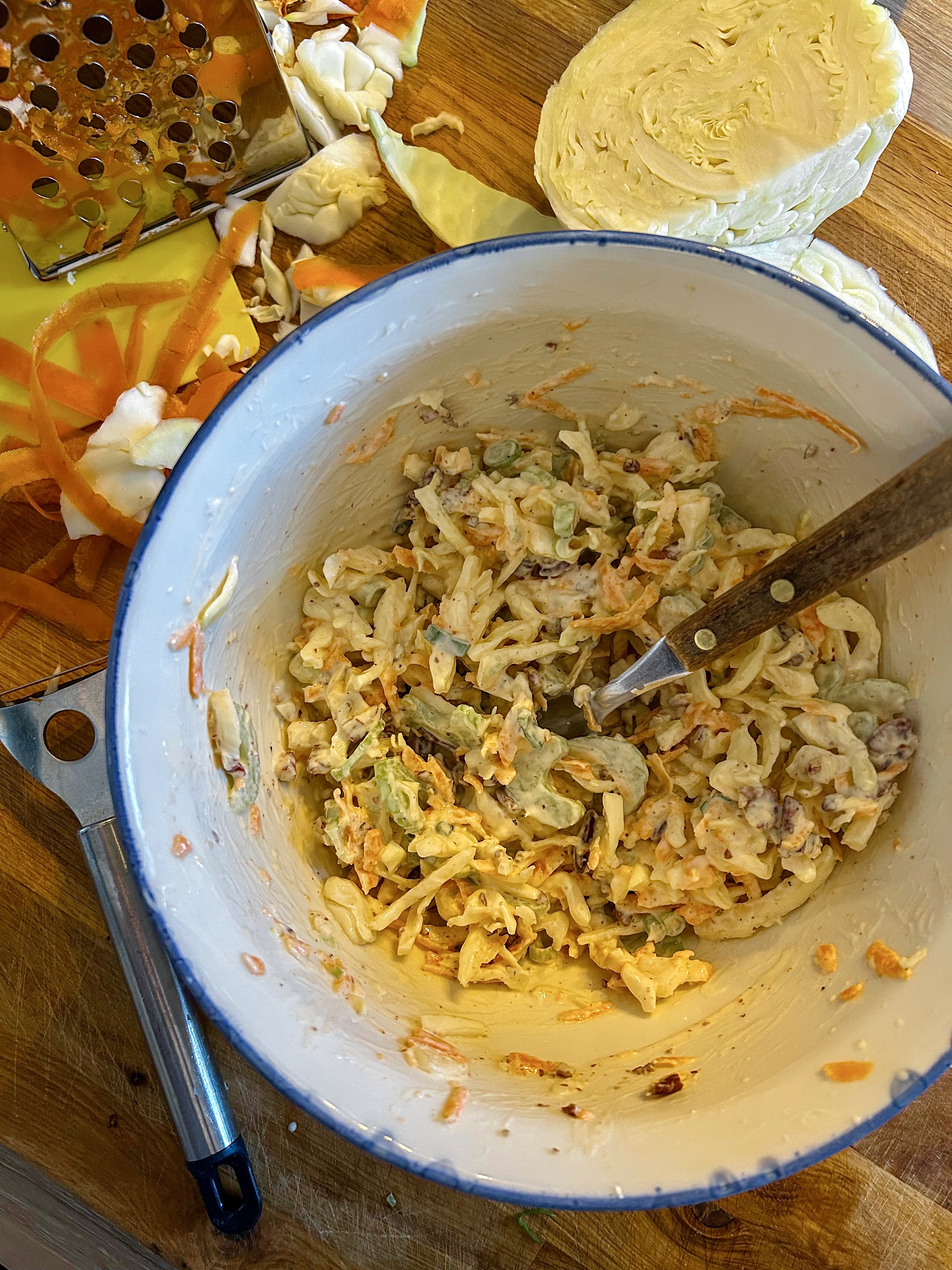
Serves 4 – 5 as a side
½ small white cabbage – finely sliced
1 large carrot – peeled and grated
3 spring onions – finely sliced
1 stick celery – finely sliced
Approx 25 – 30g pecans – roughly chopped
2 tbs Greek yogurt
1 tbs mayonnaise
1 tbs sour cream
1 tsp apple cider vinegar
1 tsp maple syrup or honey
- Put the cabbage, carrot, spring onions, celery, and pecans into a large bowl.
- Add the yogurt, mayonnaise, sour cream, cider vinegar and maple syrup or honey.
- Season lightly with some salt and plenty of fresh, black pepper.
- Fold the contents of the bowl until thoroughly combined.
- The key bit – taste and adjust. You’re looking for balance of flavours – sharp but sweet. You may want more salt and pepper (I always want more salt) but if it tastes flat, you’ll want a dash more vinegar. If it’s a little sharp or the alliums are overpowering, add a little more maple or honey. If it’s a little too loose, tighten it up with some more mayonnaise. If it’s too rich, cut it with a little yogurt. Adjust in small increments, stir well, taste again, keep going until you’re happy.
- It will keep for about 3 – 4 days in the fridge without issue, and after this, it will still be fine to eat albeit the vegetables will naturally soften and a liquid separation will be normal, just stir it.


Leave a comment