How awful to call something of your own perfect, isn’t it?
But I must continue that pomp and say something I’ve been dying to say for a while but I know pesto is so beloved that I almost need to whisper this but… most pestos are bad.
Just bad and wrong.
Look, I am an enormous advocate of make it your own and use what you have and there are no rules in cooking and not everybody has to do it like me and I will champion this culture of thinking in the kitchen until I can write no more.
The truth in that encouragement of creativity liberty, though, is… that sometimes it produces crap food.
Subjectively, of course, but that’s the beauty of democratising cooking.
However, as this is my little space to speak lovingly and opinionatedly about food (and those two things can co-exist) then I think I’m in a safe space to be as brutually honest, albeit respectfully, about pesto.
And maybe my kind of pesto is not your kind of pesto, and that’s okay, but hopefully we can get to a place where we can talk about our pesto hot takes guiltlessly and without shame.
Good, I’m glad we got here.
So, first things first… let me say…. I love pesto.
I never get bored of it and it truly is one fo the most useful little things to have sitting in your fridge.
Let’s read some pesto poetry, shall we?
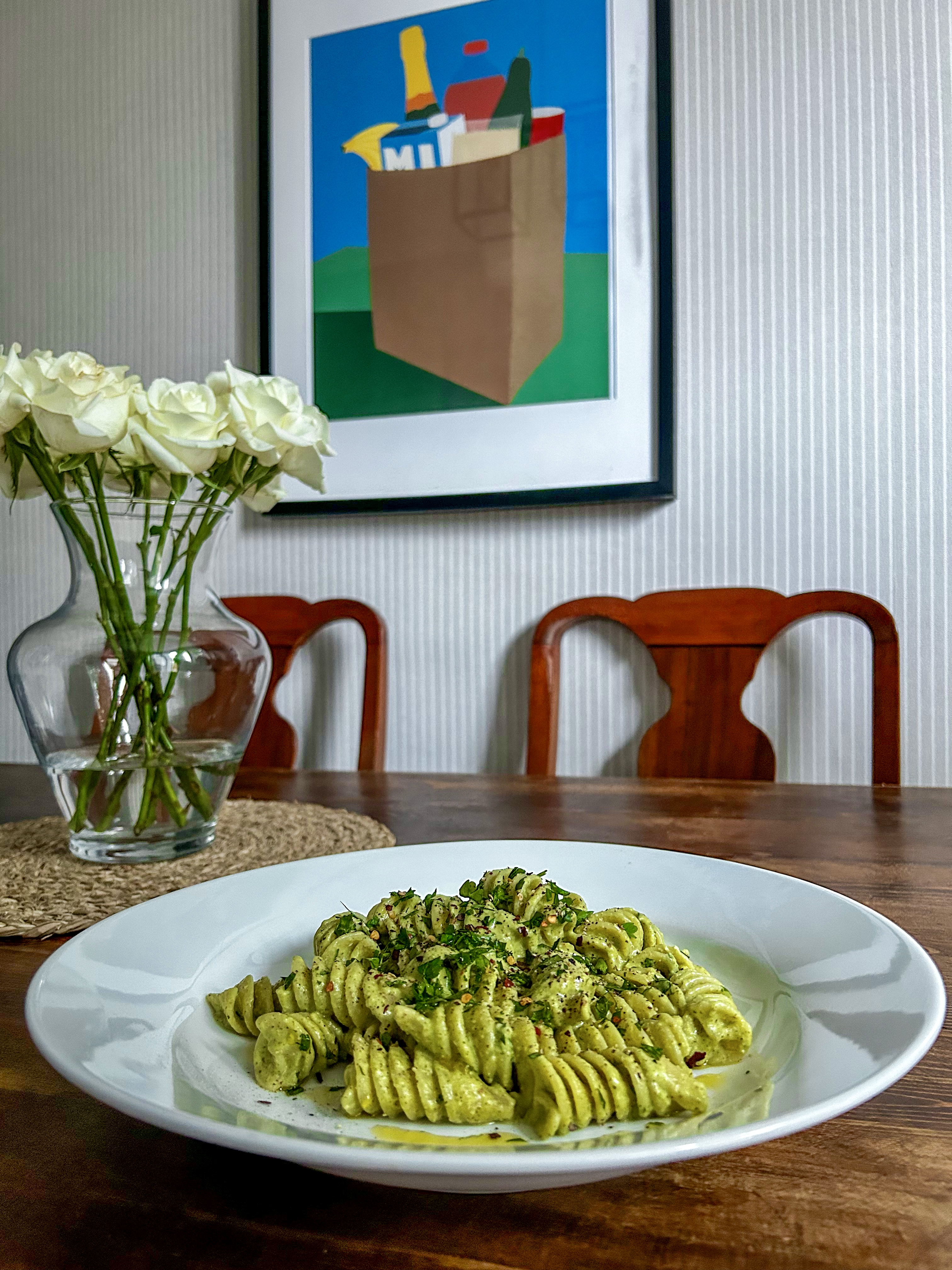
- Pasta. The original. The icon. Stirred through a golden yellow bowl of it – shape to your preference – with some more chilli flake, Parmesan and enough black pepper to pucker your cheeks, scattered over for the finish.
- Spread in between two pieces of thick, fresh cut bread and enjoyed with big, bushy handfuls of rocket and giraffe-spot burnished wedges of squeaky halloumi.
- Dribbled in thick globs over smoky, charred chunks of roasted pumpkin, butternut squash and/or parsnips.
- Puddled in the centre of a creamy balm of wonderfully pale soup like artichoke, butter bean, parsnip or leek and potato.
- New potatoes – still warm and steaming – dressed as per your perfect potato salad, but with the addition of a spoonful of pesto.
I mean, I don’t need to sell you on the beauty and possibility of pesto. If I haven’t, please go watch Salt, Fat, Acid, Heat on Netflix and let Samin Nosrat do it.
If she won’t convince you, then you’ll never, ever like pesto and here is where we end the dialogue.
However, if you’re convinced, let’s go further.
Pesto is adaptable. Yes. I agree… but to a point…
I’ve read so many, I mean literally hundreds, of pesto recipes and I think it became a trend for food writers to encourage people to make a pesto out of anything.
Carrot tops… rocket… parsley stems… spinach… kale?!
Naaaah.
Yes, I know (see also: I googled), that pesto comes from pestare, which means ‘to crush’ or ‘to pound’, so by even making this outside of a pestle and mortar, traditionally, it immediately makes it… not a pesto, so unless we’re all using a pestle mortar for this, we’re all wrong, but I want to talk specifically about flavour profiles.
I’m not bashing anybody who likes to make pesto using a mixed bag of salad leaves or pumpkin seeds or coconut oil. Honestly, have at it, I am not making fun of your pesto. I’m just saying it’s not my perfect pesto.
I’ve made so many sh*t pestos in my life to feel really confident in what I like, and while I am so opposed to any kind of rules in a kitchen, here are the pesto rules in mine.
Leaves – basil. Nothing else. I’ll die on that hill. No spinach, no mixed leaf, absolutely no kale whatsoever. Basil has the perfect blend of sweetness and pepperiness and carries a light whiff of aniseed grassiness which is what you need with everything else for balance. So it’s not even about the flavour of basil itself as a lone ingredient, fab though it is, it’s more about how it plays with everything else. Putting anything other than basil into a pesto means that you have to do so much other tomfoolery to the other ingredients and then, in my opinion, it drives too far away from being a pesto. It’s then a green sauce.
Nuts – okay, let’s talk. Pine nuts are the best. No one disputes this, right? Delicate, buttery, nubbly, they’re the best for a reason. But this is where I’m reasonable. A close second for me is almonds. My favourite, I won’t lie. They have a simnilar creaminess to pine nuts, so texturally they work, and their flavour ‘roundness’ is great. However, I need to balance out their sweetness in other ways, like a touch more pepper and garlic than I would normally. Walnuts are okay. Earthiness, creaminess, a bolder flavour profile, sure. Maybe better for autumn and winter? Hazelnuts. Nope. My pesto doesn’t need a Nutella undertone. We won’t discuss pumpkin seeds and such. It’s a no from me.
Nuts (Part II) – have you seen the price of pine nuts lately?! Absolute liberty. Use almonds, just for your purse’s sake.
Nuts (Part III) – toast them. Always.
Cheese – again, I return to basil territory here, it has to be Parmesan. It’s not optional. I don’t want your blue cheese or your goats cheese or your cream cheese. Alongside basil, Parmesan is the foundation of a good pesto because it has the umami richness to it, but more importantly, it has the body. This is what emulsifies with the oil to bring everything together as a sauce rather than a puddle of wet herbs. Any other cheese will either be too soft or too weird in its flavour profile. Pecorino if you must, but Parmesan is the number one.
Garlic – in my twenties I would’ve thrown the whole damn bulb at a pesto, but now? I am in my… mid… thirties, and for some reason, even one clove of raw garlic can mess me up. I don’t know why. I always regret it. Especially the morning after. It like… gives me a weird tonsillitis feeling? I’m strictly talking about raw garlic, here. Cooked garlic, I’ll take the lot, but when I have to use raw garlic in something, I can just about manage one clove. I know pesto gets cooked, but not enough for my liking when it comes to the acrid taste of raw garlic, so I go sensibly sparing here. Age has softened me to to the brutalities of raw garlic, and that presents itself in pesto.
Lemon – I take a liberty here and add it to taste. It just lifts everything, and there’s a lot of powerful flavours going on here with the basil, oil, garlic and nuts – it just needs a streak of some sharp, yellow activity to knit those flavours together without it becoming rich. Not traditional, I know. I’m a hypocrite, after everything I’ve said.
Texture – it’s creamy or nothing for me. I don’t want chunky pesto. I don’t want grissly pesto. I should never be something I have to chew? This is why jarred pesto’s’ tend to suck, because everything feels all bitty and separated? I want it emulsified, everything pulled together so that when it covers pasta and goes on a plate, there are no random bits of garlic or pine nut just sitting there on the plate. I want it velvety and glossy and creamy and something I can pour, because I want it to coat my pasta, not just sit beside it. That doesn’t mean cream as an ingredient and it certainly doesn’t mean a soft cheese. It unfortunately means abandoning the entire idea of pesto being bashed up by hand and relying on a stick blender. I know, I know, Someone’s Nona is somewhere spitting, but let it be so. I need it creamier than what a pestle and mortar can provide, I’m afraid. I also am not above adding a mere pinprick of cold water if it means guaranteeing extra creamy support.
So there we go.
Can you make a pesto with whatever green bits are lying at the bottom of your fridge and blitz them up with some seeds and cheese and the nearest oil to you?
Yes, of course.
Will I think of it as a perfect pesto?
For you, yes.
Will I always yearn for the pesto exactly as I’ve laid out below.
Absolutely.
Makes about 300g
50g pine nuts (or almonds)
60 fresh basil leaves
85g grated Parmesan – but keep a little more nearby just in case
½ – 1 clove garlic
150ml extra virgin olive oil – and keep the bottle near
1 lemon
- In a dry frying pan, toast the pine nuts (or almonds) for about 3 or 4 minutes, just until lightly golden and fragrant, shaking the pan from time to time to stop them catching. Don’t take your eyes off them, even for a second, because the minute you look away, they will burn to a crisp. Remove from the heat and keep to one side to cool.
- Add them to jug or bowl along with the basil, Parmesan and garlic with a small pinch of salt and black pepper. Blend everything together with a stick blender to create a rubbly mix.
- Now, slowly add in the olive oil, pulsing with your hand blender as you go until everything starts coming together smoothly.
- Add a tiny splash, I’d say just over a teaspoon or so, of cold water, continuing to pulse, until you get a very creamy, pourable consistency.
- Halve the lemon and squeeze in about a teaspoon or two of juice and then stir in with a spoon.
- How to taste for seasoning – if it tastes flat for you, add a little more Parmesan or even salt. If it’s tasting a little heavy then add a teaspoon more of lemon juice to wake it up a bit. If the garlic is a bit wild for you, you could add some more basil, but I would learn your lesson and just add less next time. But of course if it needs more garlic, grate in some more. If the oil is making it a little bitter, splash in a little more water or even some more parmesan. They key thing to be tasting here – how on point is that basil? Don’t try tasting it for lemon or garlic… really taste to see how the basil is doing because that’s the core of a good pesto. If it needs more, add more, it should be the first thing you taste – but more pesto changes the body so if you had more pesto, be mindful you may need a touch more oil or cold water just to keep the body nice and creamy.
- Keep going until you’ve found your perfect pesto, but if it’s basil-ey, light on the garlic, fresh from lemon, rich from olive oil and parmesan, and creamy and pourable then you’ve landed on my perfect pesto.
- Store in a jar with a tight-fitting lid and drizzle a thin film of olive oil on top of the pesto once it’s in the jar. This will slow down oxidation and keep it nice and fresh. It will keep in the fridge for up to five days.
- And to enjoy it? See the intro for the wonderful uses of pesto, but I will always, first, advise tossing hit through some big, fat buttery shapes of pasta with a tiny splash of the pasta cooking water added to it.


Leave a Reply