I’ll level with you here. I don’t write fish recipes all that often.
I can totally see a world where people see buying fish as perhaps being a bit of a treat or something adventurous or a break from the meat and two veg routine, and for that reason, a fish recipe extends itself to an extraordinary piece of writing that could be unique, insightful and very helpful.
I had no skin in this game.
Reason being is that I don’t like to buy whole fish (that to mean, the whole fish, head and all), not because I’m squeamish, but just because I can’t be bothered. So instantly, there goes any opportunity for a cool, interesting picture of the whole fish on a plate, or any kind of writing to accompany it that is helpful.
So I opt for fillets, and when I say fillets, I mean the vacuum-packed ones you can pick up right there in any old supermarket and, for all intents and purposes, looks boring in a picture. There I said it.
Also and as well, to top it off, I am always always buying either salmon or cod and it always goes like this:
White fish gets a glaze (this one usually), and salmon gets butter.
I stand by my theory that white fish needs a bit of pep, while salmon tastes like salmon, so needs as little doctoring as possible. Those are the two routes I go with my fillets, and that’s about as far as the imagination will stretch, and because of that, no matter how much I love these recipes, and I truly do, and no matter how often I cook them, which is often, I’ve never felt compelled to extend these enthusiasms to you for fear of it being boring.
But then I had check myself before I wreck… I can’t even finish that sentence, but still, you know what I mean. I did have to check myself.
Mundanity and repetition exists for a reason, especially in food.
When I cook something the same way again and again and again, it’s not because I’ve fallen into an everlasting loop of habit or routine, it’s just because the recipe works. It works for so many reasons. It’s reliable, it’s easy, it’s affordable, and most of all, it just tastes really, really good, and sometimes that’s not only reason enough to continue cooking about it, but to feature it here.
Remembering this made me want to publish this recipe. If I love it enough to cook it often, it needs to be here, so there we go.
So let’s get to the cooking then.
Some thoughts:
Low, low, low, slow, slow, slow – we’re talking a slow(ish) cooked salmon here, and I say slow(ish) because it’s slow but also, kind of fast? It’s slow-cooked but not in any kind of way that will have you hanging around for hours. Longer than you might assume for a small piece of fish, sure, but at a very low temperature, which is doing most of the hard work here, if truth be told.
Frying the olives – it may seem odd to fry them, especially if you’ve only ever been used to draining them from a jar and stabbing them with a little cocktail stick, fabulous though they are this way. I just like to fry them a little bit here to get some extra flavour and scorch on them. The oven will be too low to put any real burnish on them, so the early fry just gives them a little bit of an oomph so the oven can then keep them warm. Without frying them, they come out the exact same way they went in, just warmer.
Butter – don’t swap it out for oil. I mean, you can, but please don’t.
Lemon – it’s a choice, not a requirement. I like to add it because, again, salmon tastes like salmon so while I like to keep it tasting of just salmon, a welcomes a little zing of lemon and the creamy richness of the butter just lifts the salmon rather than penetrating it with anything that will fight it’s natural flavour. You could also use lime zest, if you’re feeling freaky.
Serving suggestions – the beauty of this recipe is that it takes almost zero prep and a short time in the oven. So, when I served this to my friend recently, to go with it, I pre-boiled some baby potatoes earlier that day and let them go cold. Once cold, I sliced them thickly and when the fish went in the oven, I fried them on a medium-high heat in lots of butter while I chatted to her with a glass of wine, before finishing with salt, pepper, and a leafy scattering of finely chopped parsley before serving when the fish came out. I also made a salad of thinly sliced red onions, thickly cut cucumbers that I flattened with the blunt of my knife, tossed in some lemon zest, salt, pepper, lemon juice, and olive oil. I made this in the morning and just let it sit in the fridge until I served.
Looking at the food, it looks, feels, and sounds slightly impressive. Regardless of method, it’s still a beautiful piece of slow cooked salmon with scorched, salty olives, and feels even more special when paired with the potatoes and bashed cucumber salad.
That’s all I have to say on the matter really.
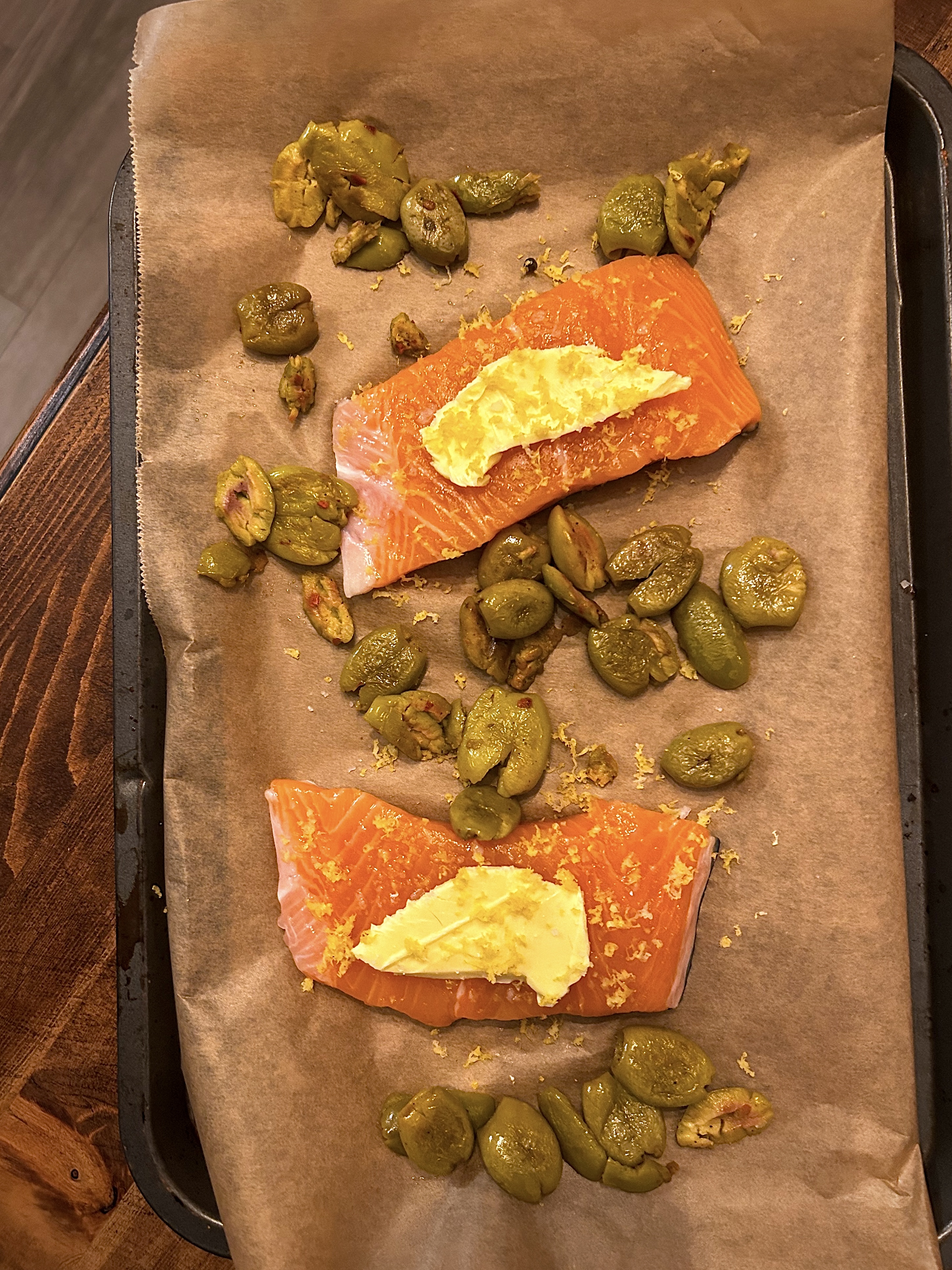
Except, addressing that the picture below is of the fish and olives before it went in the oven, of course.
If you’ve ever roasted a salmon fillet, you’ll be very aware that despite it’s beautiful, satin-soft texture and it’s wonderful, buttery flavour, it’s actually not that impressive to look at.
Just a tray of chalky, pink podge with lots of bubbly white foam around it. It’s not that attractive. But the raw fish? With all of its coral beauty and the canary yellow butter with the flecks of lemon?
Gorgeous.
Serves 2
2 tsp olive oil
20g unsalted butter + 1tsp
2 salmon fillets (roughly 140 – 160g each)
Zest of 1 lemon
60 – 80g pitted green olives (but black would be fine)
A sprinkle of dried chili flakes (optional)
½ clove garlic
- Preheat the oven to 120°C and lightly oil a small oven dish with 1 teaspoon of the olive oil.
- Lay the salmon fillets in the dish, season lightly with salt and pepper, and then place 10g of butter on each fillet.
- Grate over the zest of the lemon and then leave the tray of fish to one side to come to room temperature.
- For the olives, in a small frying pan over a medium heat, melt the remaining 1 teaspoon of butter with the 1 teaspoon of olive oil.
- Using the blunt of a knife, crush the olives on a chopping board and once the butter is foaming but not browning in the pan, toss in the olives.
- Add a twist of black pepper and the chili flakes, if using, and stir, frying for about 5 minutes until the olives start to take on a little colour and become glossy.
- Grate in the clove of garlic and stir to coat the olives. Cook for another minute or so just to heat the garlic, but now brown it. Remove the pan from the heat and tip the olives around the salmon.
- Cover the tray of salmon and olives loosely with foil and put into the oven for 25 minutes, until the salmon is just slightly set and softly flaking. I like mine bordering just ever so slightly on underdone, where it’s still a little coral in the middle, but if you like it a little more done (Mam, I mean you) then leave it in for longer. Cook until you’re happy with it, I guess?
- Serve the salmon with the olives and I urge you to see my thoughts in the intro for accompaniments. If you skipped that bit and haven’t read it, because you’re someone who likes to get straight to the recipe, that’s fine, I’m not offended, but basically I recommend some boiled new potatoes then fried in butter and parsley alongside a spiky cucumber, red onion, and lemon salad. There.


Leave a Reply