There are some breads in life that are designed to fulfil a prophecy bigger than it’s intended bake.
A big, pillow rustic loaf of white bread, for example, is a stalwart bread. It’s eager to be toast, it’s ready for sandwiches, it wants to be fried, it’s hoping it’ll be soaked in a boozy custard and baked for pudding.
But other breads can’t be bothered for all that.
Actually, other breads are stubborn. They say ‘take me as I am because I won’t be anything more than what you see’.
Focaccia is that bread; and I am forever indebted to its obduracy.
Focaccia is what it is. It will make terrible toast, has no desire to be a sandwich, will get annoyed if you fry it and has no desire to be a custardy pudding. That’s why we need to accept it for what it is – a tear bread that is BURSTING with flavour and to be enjoyed in its original form.
Thank you focaccia.
This is the ideal bread if you want maximum reward with minimal effort. There’s no kneading, no shaping, nothing, and with so many things in life, it’s a simple case of time itself doing all the work for you. It’s a dough that demands so little and gives back so much.
Some thoughts
Flour – I always, just for my own reassurance, used strong bread flour for all of my bread baking since it’s readily available in shops these days, but I have made this with plain flour in the past and it turned out fine. So use the fancy bread flour if you can, but breathe easy knowing that I didn’t in the past and I still had a focaccia.
Olive oil – I found it very difficult to estimate how much oil I need for this recipe if I’m really honest. Definitely 4 tablespoons in the warm water but the rest if really up to you in terms of greasing your tin and how much you finish with. So I say just keep the bottle close and go with your gut, unless I’ve specified exact amounts below.
Honey – helps with browning I find, but if you don’t have honey, just add 1 ½ teaspoons white sugar in it’s place.
Brine – I have specified a brine on this focaccia just before baking which is simply just the spiky brine liquid taking from a jar of olives, but if you don’t have any in, don’t worry, just use tbs water and add about ¼ tsp salt instead.
Time – I specify overnight because there are benefits. The longer the dough has to sit, the better the flavour can develop (yeast will create aromatic compounds the longer it has to ferment), it will also improve the texture because the gluten can relax and this gives a light, airy crumb with big, wide open holes. But, if you’re time poor and just need to get it done, skip the resting overnight in the fridge and let it rise at room temperature again for 2 – 3 hours until the dough has double in size, then go ahead with shaping it into the tin and baking.
Other stuff – people like their focaccia’s adorned before putting it in the oven, which is fine. Really thinly sliced red onion, some fresh rosemary finely chopped, chopped olives, some halved cherry tomatoes, capers, anchovies, thinly sliced courgette, CHEESES, lemons, figs… I mean, I’ve seen it all and have tried many of them. Are they great? Sure. But when I want focaccia, I want just a really bouncy, squidgy bread that tastes of bread, so my ideal version is below, but just know, if your kitchen permitted it, you could decorate it as you see fit.
All agreed? Good. Let’s cook.
Makes 1 big loaf
500g white bread flour
2 tsp fine salt
1 x 7g sachet dried yeast
400ml warm water
2 tsp runny honey
Olive oil (4 tbs for the water plus MORE in general – see intro, just keep the bottle nearby)
2 tbs brine from a jar of olives
- Put the flour in a very large bowl and put the salt on one side of the bowl and the yeast on the other. Make a hole in the middle of the flour using your hands to create a little empty well.
- In a jug, combine the water, honey, and olive oil and stir to combine. Gradually pour into the hole in the flours and using a spoon or a dough whisk (google one if you never seen one, they’re fabulous), gently mix the flour into the water until you can’t see any more bits of dry flour. The dough should come together into a wet, shaggy mound and look more like a sticky batter rather than a sturdy dough and guess what – you’ve done it absolutely right. If this feels wrong, it’s right.
- Cover with a tea towel and put in a warm-ish and draftless place for 1 hour. An airing cupboard or clothes cupboard is fine.
- After this time, you’ll see the dough has not doubled just yet, it has just puffed up ever so slightly. It’s loose and relaxed, and so should you be, because it’s all on track. With an oiled hand, give the dough a fold in on itself, still in the bowl, and then cover again, and put in the fridge overnight.
- The next day, remove the bowl from the fridge and you’ll see now that it is puffy, bubbling and jiggly. Take it out of the fridge about an hour before you want to bake it, and oil a 30 x 22 baking tin with lots of olive oil.
- Tip the dough into the tin and using gentle but firm hands, stretch it towards the corners so that it fills the tin as best as possible. Cover and let it rest again, somewhere warm-ish and draftless, for like an hour and in this time, you can preheat your oven to 200°C.
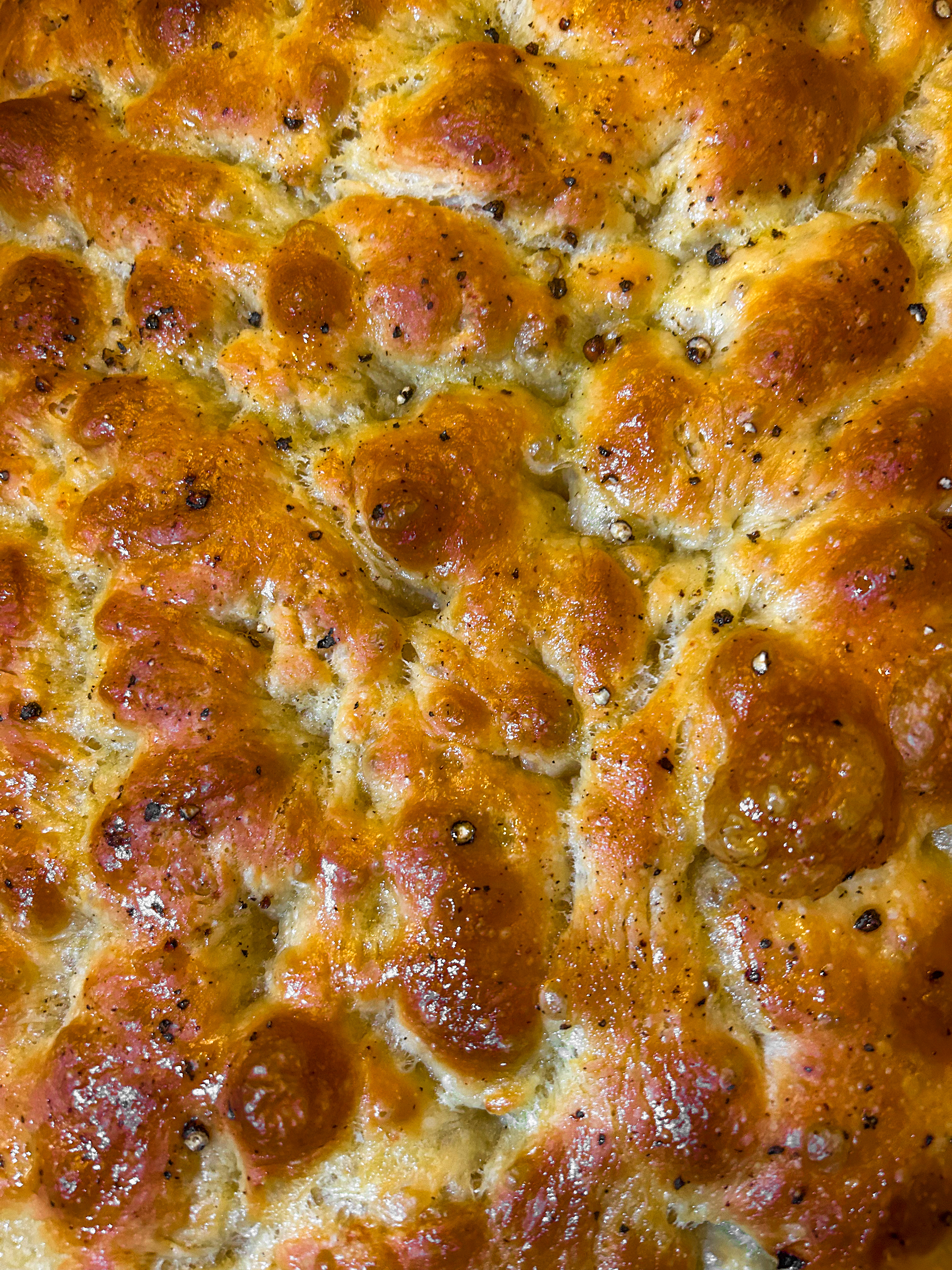
- Bring the tin from it’s hiding place and either using oiled fingertips or the pointy end of a wooden spoon, gently poke little dimples into your focaccia, but not too deep, just 1/3rd of the way down. Do this all over the dough. Can’t tell you how satisfying it is to see the dough make little, thin bubbles all over its surface. Enjoy this bit as much as you can.
- Drizzle the dough with lots more olive oil, and then take the olive brine and using a spoon, light coat the surface of the dough with it. You could spoon it over, but I like a brush because it makes me feel artistic.
- Finish with some black pepper and a little salt (go easy though because the olive oil brine is salty) and pop it in the oven for 25 – 30 minutes until slightly risen and golden on top with a crisp, olive oil-fried base.
- Remove from the oven and while it’s still hot in the tin, drizzle over a little more olive oil. Allow to cool slightly before carefully removing from the pan and cutting into squares.


 MIKEY BELL
Leave a reply to A SUNDAY DINNER – MIKEY AND THE KITCHEN. Cancel reply