I have a very easy, weeknight mac and cheese recipe that I make on autopilot.
This is not that recipe.
Yes, it’s still very easy and could be made on autopilot, but this recipe is actually a twist on my actual mac and cheese recipe. I’ll explain.
This recipe exists because I was once put on Instagram that I like to put a few shiny shakes of Frank’s hot sauce on my mac and cheese, and then a lovely follower replied telling me that they put sriracha on theirs.
And then I thought ‘yes… perfect… sounds amazing… THAT… but also… what if… more?’
I wondered if there was something I could do to push that thought, that idea, that genius spark of wonder, into a direction that could uphold that similar flavour profile, but in a way that came from inside the recipe, not just on top of. Get what I mean?
And so I pottered in my kitchen, and wound up with this recipe.
While I remember – I can’t recall for the life of me who told me about their sriracha addition to mac and cheese which inspired this recipe, so if that was you, please, please make yourself known so I can credit and thank you properly!
Anyway.
I am so thrilled with this recipe. I’ve been cooking it for just over a year or so now, certainly when I was in my old flat, but life and time just meant I could never really finesse it and craft and shape it into a recipe I was happy to share, but with time and space now afforded to me, I have been able to, and it fills me with joy that I can finally add it into the canon of recipes I cook on repeat – the true criteria for a recipe to find it’s way to this website.
The first time I made this, I literally just made my usual mac and cheese recipe, and added a dollop of gochujang at the end, stirring it through the finished product. It was fine. Just fine. But it needed more thought. It needed a more complex flavour profile to uphold everything that gochujang is.
Gochujang is deep, savoury, spicy, fermented, and also a tiny bit sweet, and while all of that does not need too much rescuing, it does benefit from a little company. So while the technique and method for this mac and cheese is largely similar to what you would expect from a regular version, I have made some tweaks where I thought they were important.
For example:
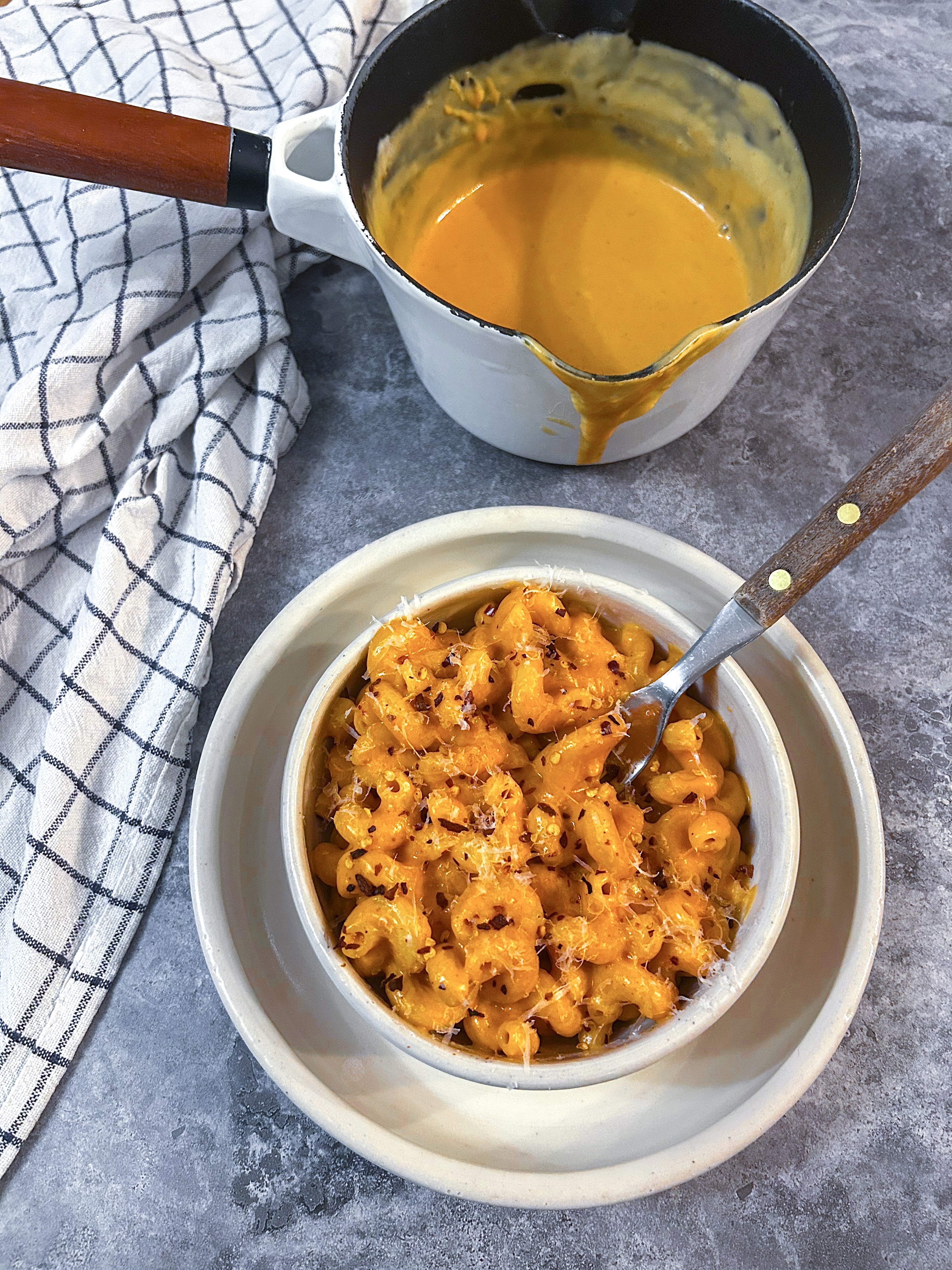
Tomato paste – I needed it, if I’m honest. There’s a small part of me that needed just a tiny bit of sweetness to kind of round out all that chilli and vinegar in the sriracha, because cheese alone didn’t feel like a suitable balance. Also, just from an aesthetic perspective, I wanted it a little more on the sunset orange side as opposed to my usual custardy yellow mac and cheese. I’m not always fussy with how things look, but I wanted this bowl to look inviting and playful, noticeably wilder than its yellow cousin, so I wanted the red dye of tomato paste.
More garlic – there’s no garlic in my usual mac and cheese, and yes sriracha already has garlic in it, but I wanted more, I must say. I felt the gochujang transforms this dish into something much bolder and more confident, so it could hold the extra flavour. If you’re not a massive garlic fan, use half or omit altogether. You won’t miss that it’s not there, but you will appreciate it when it is.
Flavour and warm the milk – I like to whisk the gochujang, tomato paste, and garlic into the milk and warm it first before making the cheese sauce. This means that the milk can properly infuse with the flavours and gives time for the garlic to activate and simmer out its sharp edges. I don’t bother doing this with a normal mac and cheese, obviously.
No baking – I like to put my regular mac and cheese into a buttered dish, cover in more cheese, and then bake so that I can not only have a more robust structure to the pasta when spoon out, but also to have some charcoal, burnished bits on top. This just doesn’t need that. It needs and wants to be loose and slippery and eaten straight after cooking.
Restrained cheese – with my normal mac and cheese, I like to mix a few cheeses to get a complex construction of flavours, because the cheese is really the star of that dish. But the gochujang does the heaving lifting here, and I don’t want the gochujang and the cheese to battle, so I keep it simple with mature cheddar for that lovely, melty, pouring-style body (and to calm down the gochujang a little bit) and then finish with a little bit of Parmesan, nothing overly rich.
Any pasta goes – I’m slightly more fervent when it comes to my regular mac and cheese pasta choice, wanting only ever to use macaroni (maybe at a push some penne if I’m struggling) but with this recipe, I felt less austere about it. Almost whimsical. It’s already a funny little recipe, so it could hold a funny little pasta shape. Why not? Although of course, from a purist perspective, if I’m adding gochujang and using only one or two cheeses and not using macaroni then is this even a mac and cheese at all? I don’t care. I’ll let someone else fight/defend that.
So, there we go. My only other thought is, I promise when you make this, you will have to force yourself to make a mac and cheese the regular way again, and that is the kind of emotional conflict I enjoy in the kitchen.
Let’s cook.
Serves 2
250ml full-fat milk
1 tbs tomato paste
1 – 2 tbs gochujang paste (depending how hot you like it)
1 garlic clove
20g unsalted butter
20g plain flour
150g short pasta (macaroni, penne, shells, go mad)
50g mature cheddar – grated
Parmesan – to serve
Dried chilli flakes – to serve (optional)
- In a small saucepan, combine the milk, tomato and gochujang pastes, and finely grate in the garlic clove. Whisk gently until the pastes have loosened, and then put on a medium heat until just steaming, but not boiling. Remove from the heat for now.
- In another saucepan and over a medium heat, melt the butter until gently foaming but not browning, and smelling slightly nutty. Add the flour with a tiny pinch of salt and stir, cooking for roughly 2 minutes until pale and smooth.
- Pour in a small splash of the warm, pinky milk and stir with a spoon to loosen the flour and butter. Swap your spoon for a whisk, and gradually add the milk, starting with small splashes and whisking as you go until the milk is used up. At first it will thicken quite dramatically, and you’ll worry it’s gone wrong, but it hasn’t. Just keeping gradually adding the milk, whisking as you go. It will eventually relax into a sauce.
- Lower the heat and just keep warm on the hob, whisking now then, while you get on with your pasta. Tale as old as time here, just cook it to packet instruction in salty water. I’d say al dente like I like cook it, but not everyone likes that, so cook it as you like.
- When your pasta is almost done, perhaps with 2 or 3 minutes to go, add the cheddar to the sauce, and whisk until fully incorporated and melted.
- Drain the pasta and tip into the cheese sauce, folding with a spoon so that every piece of pasta is coated in the orange, glossy sauce. You will want to eat it then and there, straight from the pan, but at least try and force yourself to pour it into two bowls. There may be a little bit of sauce left in the pan, just scrape this with a spoon, blow it, and eat is secretly.
- Serve while the sauce is still silky and loose but clinging to the pasta for dear life. Serve with some fresh black pepper, a grating of fresh parmesan, and a few dried chilli flakes, if you’re a fire worshipper like me.
 MIKEY BELL
Leave a comment