There is a reason I’ve not called this a classic or authentic Bolognese, and that is because, nothing in my cooking, ever is. It is only authentic to the rules of my kitchen, and even then, I am flexible.
Allow me to explain.
No matter how many websites I scroll or how many cookbooks on Italian cooking I read or how many Italian mothers I speak to about it (and I have…), there will never be one definitive scripture for a classic recipe, especially with Bolognese, as there are only suggestions of it’s legacy, passed down and down through generations like juicy gossip.
And like juicy gossip, we can add and embellish as we see fit depending on the company we keep.
So when a Bolognese does pass through your kitchen, I’m sure you feel no way about checking your phone for a butt dial and starting a gossip sesh, with all the embellishments and additions you see fit.
From my research, I don’t think how I personally like my Bolognese differs so wildly from the other definitions of classic, so as a food writer I do have a sweatless brow when I publish a recipe like this. However, while I feel I have been guided firmly by the hands of classic Bolognese cooks before me, I have also found my own way of being like ‘Yes great, but also why not this too?’ and made my own version. My own gossip, if you will, because that’s cooking. I expect/hope people to do it to my recipes, for I do it to others, and therein lie the lifeblood of cooking.
I see this more in Bolognese than I do anywhere else. Everybody has their own version and everybody would raise an eyebrow at the way you do yours, I’m sure, because when something is so personal, when it differs from your own traditions, it jars. It’s like a Sunday Dinner or making a bed. Yours might be good, but mine/my Mum’s is better, is always the thought pattern.
That’s without even bringing in the millennial pull towards a Bolognese.
If you’re a millennial, I’m almost certain that the Bolognese is something that reminds you of coming home from school. It’s that thing your parents would cook, particularly during 90’s Britain, when the Italian ‘dining in’ boom happened and pre-made sauces started popping up in supermarkets and pasta kind of replaced the meat-n-two-veg as the meal we saw the most often at the dinner table. Shout out to British mums having a Silk Cut in the kitchen in their slippers, stirring pre-made Bolognese sauces and plopping it on top of cooked spaghetti for your kids to eat when they get home from school. We owe you.
Having done my spiel about authenticity in cooking, I must reiterate the point, while I will never claim a dish of mine to be authentic to its own culture, creation and legacy… I will always explore how a recipe can be authentic to me, my cooking style, my preferences, and my kitchen… and with a Bolognese, I have some opinions… so here goes nothing.
Meat – somewhere over time the Bolognese became a beef mince exclusive thing, right? Let’s right that wrong. I find that a bit much and only ever use a beef-only meat sauce when I’m playing with other flavour components, so for a Bolognese, I cut it with pork mince (plucked straight from a sausage) at a rough 70:30 beef to pork ratio, and I like the beef to be 20% fat if possible to keep the silkiness. This is common with old Bolognese recipes. However, so is the addition of bacon, which I don’t include, because meh. I have the pork mince, I don’t need the bacon.
Wine – now I know y’all would assume it’s red, right? But I go for white, something dry and drinkable but nothing too expensive. Would red work? Sure, but again, we’re playing with big, bold flavours here so the white just tempers the richness.
Vegetables – I want an onion, carrot, celery, and a garlic, and that’s that. I see garlic missing from a lot of Bolognese recipes actually, but I find I need it. I also, quite shamelessly, always use a food processor to blitz these. Yes, you can chop all by hand and it would be fine, but a Bolognese sauce is already quite a chunky affair, I don’t want random pieces of carrot or celery all up in the business. A processor just gets everything uniformly as tiny as possible, which is what I want. Not puree, not mush, just chopped tiny. It’s a laziness thing too, just adding for total transparency. You could swap out the onion colour (I go white, but you could go red?) but that’s where I end the substitutions.
Seasoning – fennel seed is my little personal addition here. I made a meat-free tomato sauce once for a simple pasta sauce and included a fennel bulb in it and loved the contrast between the almost citrusy aniseed-y flavour of the fennel against the sweetness of the tomatoes, so I wanted to feature the same profile in my Bolognese. I didn’t want an entire fennel in the ordeal and didn’t want to waste a fennel just for a small bit of it, so I found a fabulous happy medium in fennel seed. Leave it out if you don’t need, have, or want it. Nutmeg also, because of its subtle but hugely beneficial transformative power to add warm, nutty spiciness to the meat. I wouldn’t recommend leaving this out. It won’t be awful for not having it, but it will be so much better for having it.
Milk – I know, right? It’s a leap of faith and will feel wrong, but it’s actually found in a lot of classic recipes. There goes that classic word again, but I find it makes an enormous difference in that it balances the acidity in tomatoes, which gives a rounder flavour but also the fat in the milk adds a wonderful silkiness to the sauce, helping it cling beautiful to the pasta. If you want to be a heathen and make this incredibly deluxe, you could do a 50:50 split of milk and double cream, but do you. Full-fat milk is full-fat fine with me.
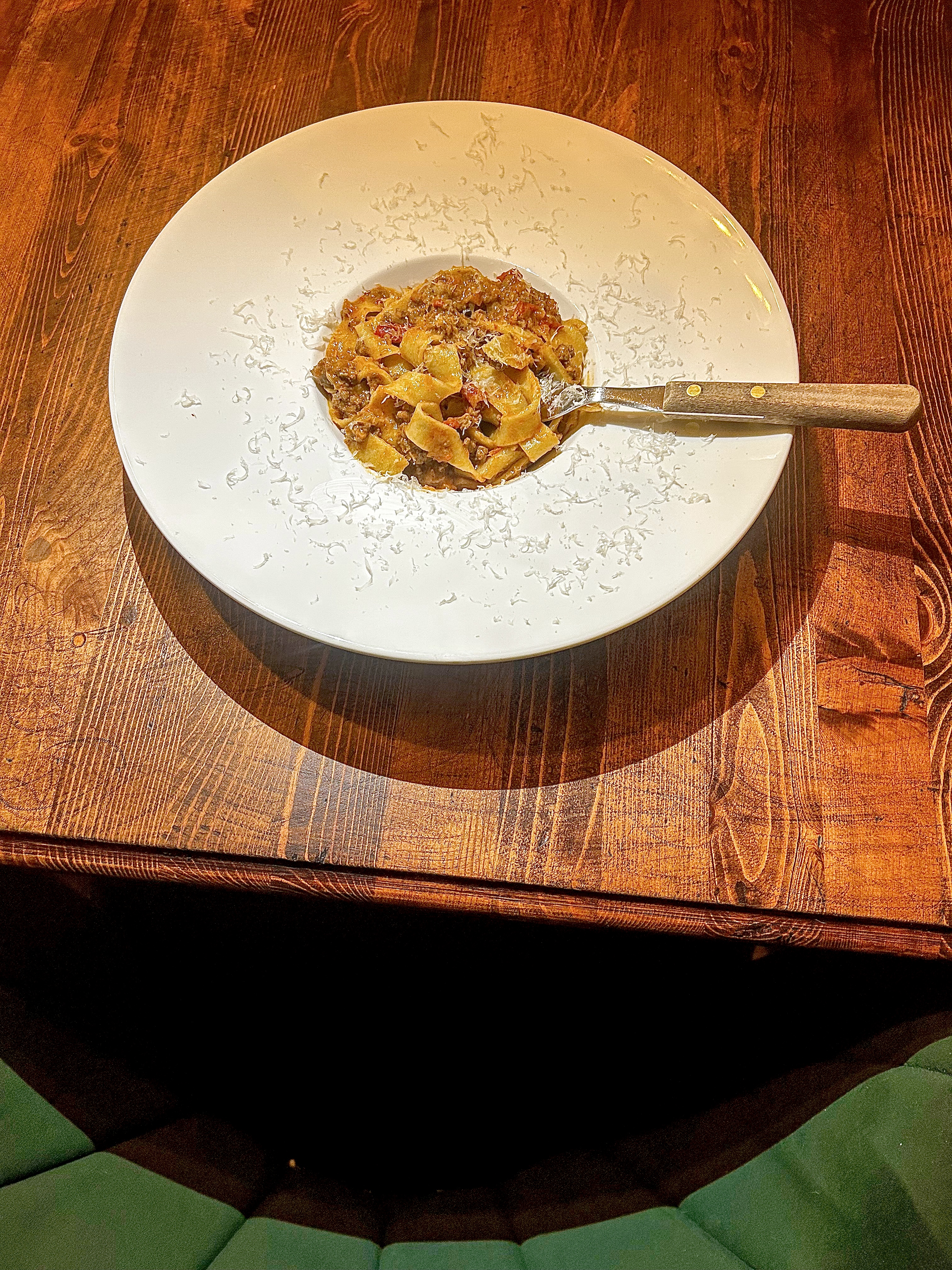
Pasta – now… listen… I have a strong opinion here. I don’t know how or where it happened but at some point, everyone started serving Bolognese with spaghetti and I think we need to have a word, just as a society. Spaghetti is for thin, light, creamy pasta which Bolognese… rightly so… is not, nor does it want to be. Bolognese needs something tougher and sturdier, something that’s presence is felt, not just as a vehicle for sauce, so I will always opt for tagliatelle. I was about to say ‘or…’ but there is no ‘or’. It’s always tagliatelle for me, and if I don’t have any when I make a Bolognese, I go out and get some or make some fresh (I don’t have the strength for that in this post). Use spaghetti if that’s your preference… I guess… but not me.
Finishing herbs – no thanks. I don’t want parsley, basil, rosemary, thyme, or any other of the ol’ girls, on this plate. Herbs, I love and adore you, I would lay down my life for you, but you’re not necessary here.
My non-negotiable rule – I’m fairly flexible on some things in my kitchen, but in some circumstances, I am militant. One rule I would go to war for? Dressing pasta. I can’t stress it enough. I don’t ever want to see a plate of plain pasta presented with the sauce just spooned on top. This isn’t the school canteen anymore. DRESS YOUR PASTA. Drain it so that it still has a tiny bit of the cooking liquid on it. Put it back in the pan. Spoon the sauce into the pan… not too much… just enough to coat. Stir the pasta gently. Put the pasta in a bowl. I will say it again, and I also want it etched into the walls of my tomb, dress your pasta.
So while my recipe is not a thousand worlds away from what you find in the pages of an old Italian cookbook, it does have a few tweaks to the ingredients and methods that just cradle it into what is authentically mine for today, an approach I hope you take with you, not only with pasta sauces, but any cooking.
Serves 4
1 onion
1 carrot
1 celery
1 clove garlic
25g butter
1 tsp olive oil
400g beef mince
3 x pork sausages (no funny flavours)
1/2 tsp fennel seeds
A grating of fresh nutmeg
1 tbs tomato paste
200ml white wine
1 x 400g can chopped tomatoes
200ml good beef stock
150ml full-fat milk
- Blitz the onion, carrot, celery, and garlic in a food processor until it’s a pile of vegetable rubble. Or, of course, chop by hand. It’s up to you how you get to a pile of chopped vegetables in front of you, but I go with the processor. Just make sure they’re chopped as uniformly small as possible.
- In a large pan and on a medium heat, warm the butter and olive oil until the butter is a golden puddle, and then add the vegetables with a little salt, cooking for 4 – 5 minutes until softened.
- Add the beef mince and then remove the sausage meat from their skins, and add the meat to the pan with a little more salt and some black pepper. Using a spoon, break the meats up (pressing down and twisting) so that they’re not frying in clumps, and cook for another 4 – 5 minutes until just about losing their rawness.
- Add the fennel seed, nutmeg, and tomato paste, cooking for a further 2 minutes or so, before tossing in the wine and cooking until the wine has reduced by half.
- Stir in the can of chopped tomatoes and the beef stock, increase the heat to bring the pan to a boil, and then drop the heat to a gentle simmer. Leave, uncovered, for about an hour, stirring now and then. You want it bubbling enough to know it’s alive and kicking, but not so alive and kicking that it’s boisterously sputtering red bubbles all over your kitchen counter and wall.
- After this time, gradually add the milk, stirring gently as you go. This will change the colour of your sauce from a deep red to a slightly paler, terracotta colour, but don’t worry. This is what we want right now. Once the milk is fully incorporated, leave to simmer, uncovered, for another hour, stirring now and then, until it is thick and glossy.
- Taste for seasoning, you may want to add a little more salt and pepper depending how salty your stock is, and then remove from the heat.
- You could serve straight away, keeping warm on a back hob while you prepare your pasta (and please see my intro for strong thoughts on this), but I like to give it a little rest, maybe for 2 – 3 hours and then reheating gently on low. It can also be refrigerated for 3 – 4 days in an airtight container or frozen for 2 – 3 months.
 MIKEY BELL
Leave a comment