If you’re searching for the best way to roast a chicken, this is mine.
Honestly.
To say it’s the only way I roast chicken is a lie, because one single search for the word CHICKEN on my recipes page will show that I like chicken in many forms, but what is true to say, is that this is my favourite way to roast a chicken.
It can apply to all chickens,
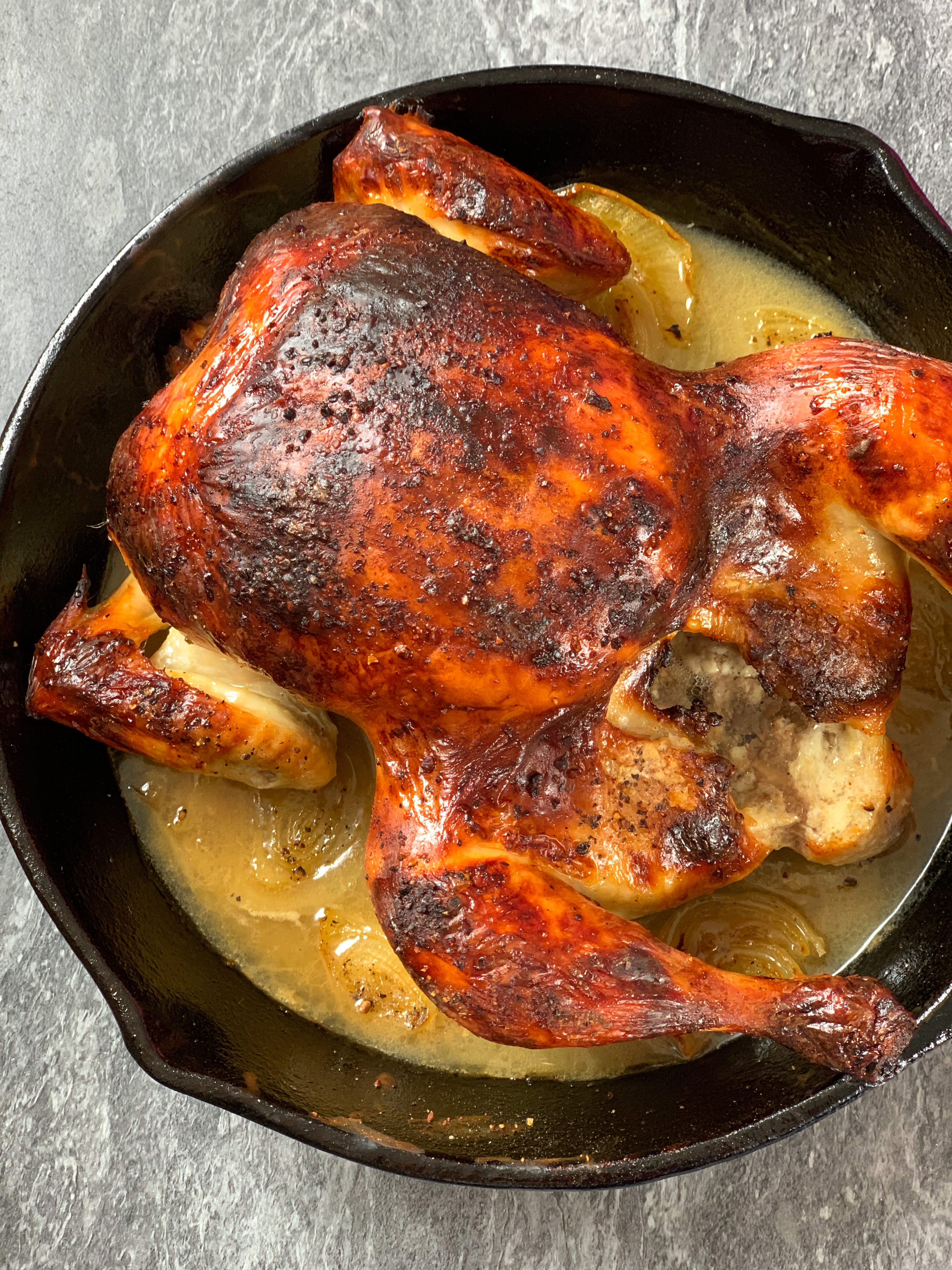
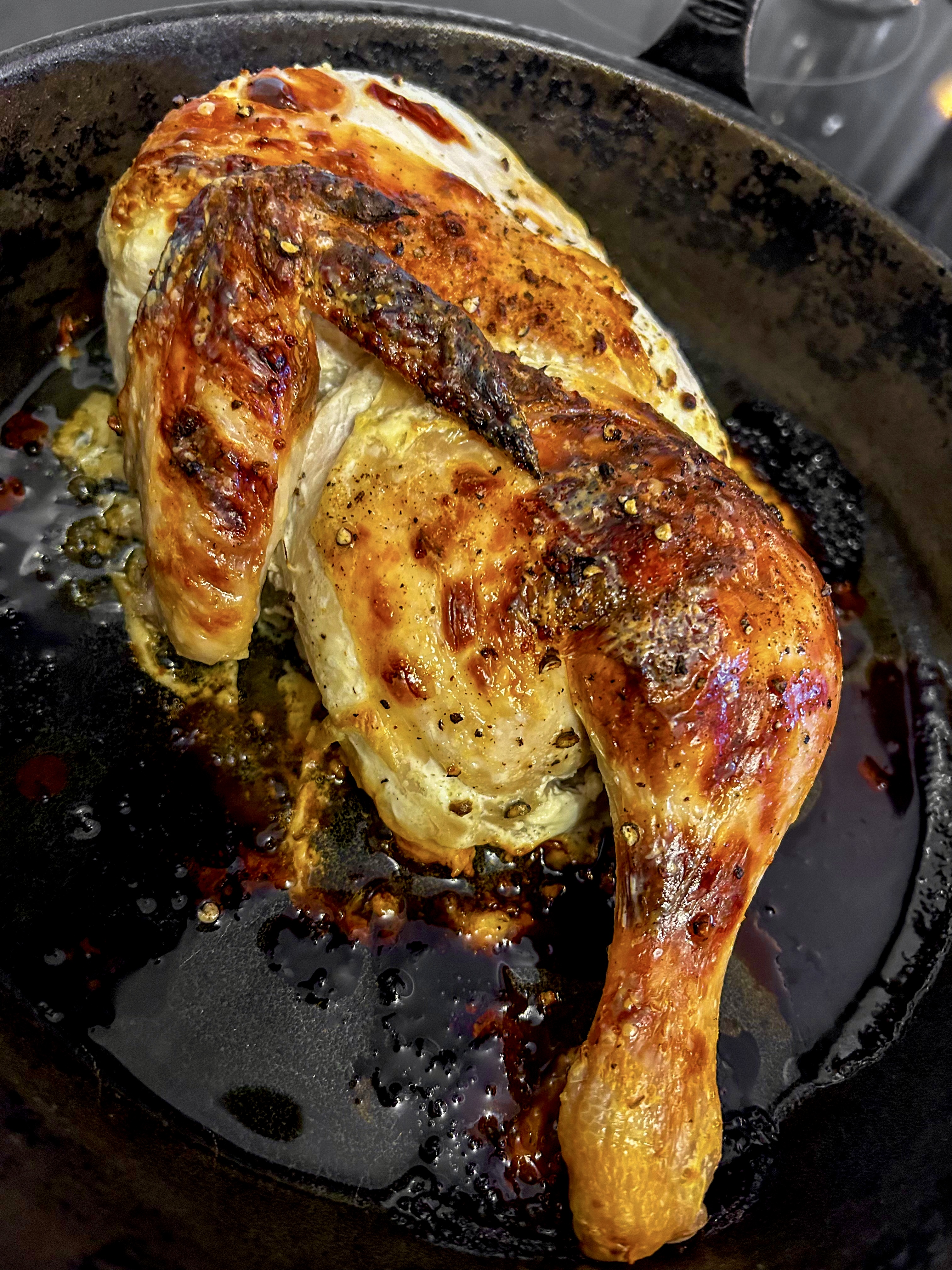
Whole, halved, wings, thighs, legs, and everything in between and thereafter, just marinated overnight in some garlic-spiked yogurt. That’s all we’re talking about here, and it offers the best roast chicken you will ever have tasted, and I can say that with my entire chest. It’s flavour comes from roasting that marinated bird until it’s gorgeously burnished on the edges and tattooed with these really unique giraffe-like golden spots. It’s as simple as it sounds and tastes so much better than I could describe.
But let me try.
So let’s talk about flavour..
The acidity in the yogurt will tenderise the meat, meaning the salt and garlic and tang of the yogurt penetrate the chicken more deeply so that flavour isn’t just sitting on the skin, which is often what we can get with a roast bird when it’s slathered in butter or moisturised with oil – fabulous though they are too.
The yogurt coating the chicken will also boss up in the oven, and as it cooks, will caramelise in browned, flavour-packed pockets, so even though the yogurt is doing it’s job to flavour it inside out, it’s doing double duty on the surface to make sure the entire thing is a riot.
Now, let’s talk structure.
The acidity, we’ve already mentioned her, she’s an angel, will make the meat so soft and melty, you will not believe it. Well you will, because it’s science, apparently. So the enzymes in the yogurt break down the proteins of the meat over time, but not entirely to make it a flabby mess, but just enough to improve the texture, softening it, and helping the muscle fibres retain moisture so that when you roast it, it stays juicy.
And guess what?
That also means the cooking time is much more forgivable.
Not drastically so, don’t go mad and leave it in the oven forever, but the tenderising of the meat means it could stay in the oven just slightly longer than you would have with a normal roast chicken. Not because you need it in the oven for any longer, but because it can sustain that level of heat for longer, which is fabulous if you are cooking this chicken alongside a few other things that make it a logistical headache.
That’s why this is the perfect method for a Sunday roast dinner, and I did actually include a version of this recipe in my breakdown of a roast dinner here. The roast chicken herself is below.
Isn’t she gorge?
So let’s talk variations.
Dairy – I go for yogurt. In total honesty, this is because yogurt is much more readily available in the shop. You can buy an entire bucket of it in the shop now for a very reasonable cost. Plus, yogurt gives the most cling and caramelisation because it’s a thicker consistency. However, buttermilk works beautifully. Having said that, when I am sans yogurt, it’s rare that I just have buttermilk lying around, so instead I sometimes use whole milk and use a little extra splash of vinegar or lemon juice. I’ve even just milk that just slightly gone off too. Judge someone else.
Greek vs natural – wevvz really. I haven’t noticed a difference between the two, if I’m totally honest. I personally prefer Greek for its thick, creamy, cloying consistency to the chicken, but natural would be fine.
Marinating – overnight is my preferred, but it could go for eight hours. Nothing less, sorry.
Spices – depending on what chicken cut I’m marinating and what for, I do sometimes spice up the dairy. If I’m doing wings for example, I will add some Frank’s hot sauce to the marinade. If it’s legs for a quick supper of potatoes and vegetables, I may add a spoonful of Dijon mustard. You can kind of do what you want here. Some dry spices are also good, maybe some smoked paprika, chilli and cumin?
Herbs – I sometimes throw a herb in. Not always. Thyme or oregano, usually. Can’t say it does a massive amount of difference, but I throw them in if I have some going to waste.
Okay, so the recipe below will cover you for both half a chicken and a whole chicken.
In terms of cooking times, you’ll be cooking the bird for as long as you need to cook the bird you have, meaning, the half chicken will obviously take less time than a whole damn bird.
However, important note, keep an eye on browning.
No matter what bird you’re roasting, just be mindful that because of the milk sugars in yogurt, the skin can colour quite quickly. A lovely problem to have, because brown birds mean beautiful flavour, flavour, flavour, but we also don’t want it burnished to a cinder, do we?
So keep an eye on your bird as you go and if you think it’s browning far too soon than you’d like, just loosely tent it with some foil.
Fab.
Let’s go.
Serves 2 – 3 as a half chicken, 4 – 6 as a whole
Side note – if you want some guidance on how to halve a chicken, click here.
For ½ chicken (approx.. 800g)
200g Greek yogurt (or natural)
1 tbs apple cider vinegar (or white wine vinegar)
2 garlic cloves – grated finely
1 ½ tsp sea salt
Black pepper
1 x ½ chicken
1 tbs olive oil
For a whole chicken (approx.. 1.5 – 2kg)
350 – 400g Greek yogurt (or natural)
1 ½ tbs vinegar
4 garlic cloves – grated finely
3 tsp sea salt
Black pepper
1 whole chicken
2 tbs olive oil
- For the marinade, I find this easier to make in a ziplock bag, rather than a bowl or a pot, more so for ease of storage in the fridge. Of course, if you don’t have ziplock bags, you can do this in a big bowl that you can cover and fit in the fridge, but if doing it this way, I recommend turning the chicken around every now and then so ensure even coating and marinating. So, into a large ziplock bag, combine the yogurt, vinegar, garlic, salt, and some pepper
- Take the chicken and add to the bag (or bowl) and seal tightly. Massage the chicken, to give both the marinade a chance to combine thoroughly, but also to well-coat the chicken.
- Cover and refrigerate for at least 8 hours, but ideally overnight.
- The next day, remove the chicken from the fridge and allow to come to room temperature. In this time, preheat the oven to 180°C.
- Take the chicken from the marinade, and try as best as you can to remove as much of the yogurt from the chicken as possible. It will feel almost impossible to do this without using a cloth or kitchen towel, but use neither, just use your hands as much as you can over the ziplock bag or sink and do your best. Some yogurt still clinging to the chicken is not only fine, but a little bit desired.
- Now place the chicken in a roasting dish, cover with the oil, a little bit more salt and pepper, and then roast. For a half chicken – go for 50 – 55 minutes until golden. For a whole chicken – go for 1 hour and 15 – 20 minutes, depending on the size. Whatever you are roasting, you are looking for the juices to run clear in the thickest part of the bird, and an internal temperature of 75°C. I also recommend cranking the oven up to 200°C for the last 10 – 15 minutes if your chicken hasn’t browned too quickly (see intro).
- Remove the bird from the oven and let it rest for about 10 – 15 minutes before carving and serving.


 MIKEY BELL
Leave a comment